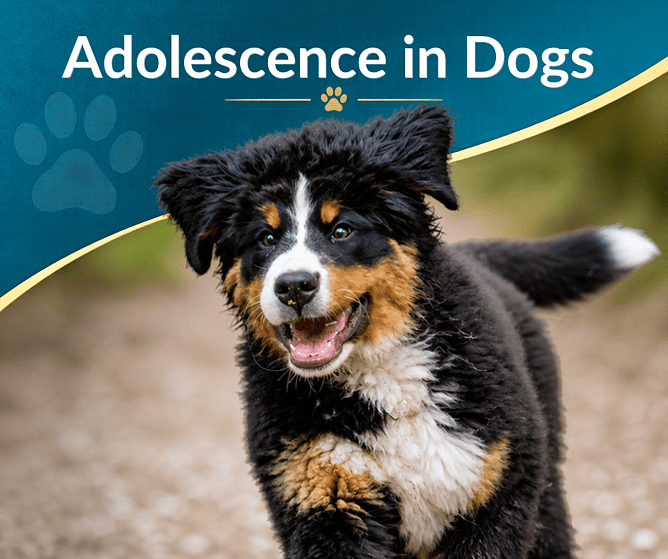
Adolescence in Dogs -Understanding the teenage stage of your dog's development
Adolescence is a normal and important stage of a dog's development. Much like human teenagers, adolescent dogs are going through significant physical, hormonal, emotional and neurological changes.
This period can bring some challenging behaviours, but understanding what is happening during this stage can help us support our dogs with patience, consistency and appropriate training.
When Does Adolescence Begin?
Adolescence typically begins somewhere around 6 months of age and can continue until 18–24 months or longer.
The exact timing varies depending on the individual dog, particularly their breed and expected adult size. Smaller breeds often mature earlier, while larger and giant breeds can take considerably longer to reach social and emotional maturity.
It is important to remember that physical maturity and emotional maturity do not necessarily happen at the same time. 😉
What is Happening in the Brain?
During adolescence, a dog's brain is continuing to develop and reorganise. These changes can influence how they respond to their environment, regulate emotions and make decisions.
There are three important areas to understand:
The Prefrontal Cortex – Thinking and Decision-making
The prefrontal cortex is involved in impulse control, decision-making and regulating behaviour. These functions are still developing during adolescence.
This may mean your dog finds it harder to control impulses, remain focused or make good decisions when faced with exciting or distracting situations.
The Limbic System – Emotions and Motivation
The limbic system includes several brain structures involved in processing emotions, motivation, memory and responses to environmental experiences.
Changes in how these systems develop and interact can influence emotional responses. Your dog may become more sensitive to certain situations, more easily excited or less confident in environments they previously found comfortable.
Hormones and Neurotransmitters
Hormonal changes associated with sexual maturation can influence behaviour, motivation and social interactions.
Neurotransmitters, which are chemical messengers in the brain, also play important roles in learning, motivation, reward and emotional regulation.
Together, these developmental changes can make adolescence a period of increased sensitivity, excitement and sometimes unpredictable behaviour.
What Might Adolescence Look Like?
You may notice some changes in your dog's behaviour, including:
Apparently forgetting their training: Behaviours they previously performed reliably may become less consistent, particularly around distractions.
Reduced focus: Your dog may become more interested in exploring their surroundings than listening to you.
Increased independence: They may be more interested in making their own choices and exploring away from you.
Impulsive behaviour: Excitement can make it harder for them to pause and think before acting.
Changes in social interactions: Relationships with other household dogs may change as your adolescent dog approaches social maturity.
Changing responses to other dogs: Your dog may become more selective about their social interactions.
Increased environmental sensitivity: Some dogs become more cautious or reactive towards unfamiliar people, animals, objects or situations.
You might also notice that the easy-going puppy who seemed happy to meet everyone is becoming a little more selective about who they want to interact with.
Remember, these behaviours are not necessarily signs of stubbornness or deliberate disobedience. They can reflect a dog who is still developing the skills needed to navigate the world.
Understanding Fear Periods
Some dogs experience periods of increased sensitivity during development. These are commonly referred to as fear periods.
During these times, a dog may become more cautious or show an increased fear response towards things they previously accepted without concern.
However, fear periods do not happen at exactly the same age in every dog, and not every dog will experience obvious fear periods.
If your dog suddenly becomes worried about something:
Avoid forcing them to approach or interact with it.
Give them space and the opportunity to move away.
Use positive reinforcement to build confidence.
Allow them to investigate new experiences at their own pace.
Keep experiences calm, safe and positive.
Our goal is to build confidence, not overwhelm them.

What Can We Do To Help?
This is one of the most important stages to continue investing in your dog's education.
Patience and understanding
Remember that your dog is still developing. Try not to become frustrated when previously learned behaviours become less reliable. They may need additional support and practice.
Go back to basics
Revisit the foundation skills your dog has already learned. Practise in familiar, low-distraction environments before gradually increasing the difficulty.
Keep training consistent
Short, enjoyable and regular training sessions are often more effective than long sessions. Reward the behaviours you want to see and give your dog opportunities to make good choices.
Continue socialisation
Socialisation doesn't stop when puppy class finishes. Continue providing positive, controlled experiences with different people, environments, sounds, surfaces and other suitable dogs.
Remember, socialisation is not about meeting every dog or person. It is about helping your dog feel comfortable and confident in the world around them.
Provide appropriate outlets
Adolescent dogs have plenty of energy and curiosity. Provide opportunities for sniffing, exploring, enrichment, play, rest and appropriate physical activity.
Keep learning!
We strongly recommend continuing your dog's formal training and positive social experiences for a minimum of 12 months after bringing your puppy home, and ideally throughout adolescence.
If you finished puppy school and haven't continued training, it's certainly not too late to get back into it!
At Pawsitive Connection, we believe that ongoing education helps build confident dogs and stronger relationships between dogs and their owners.
Our Fundamentals classes are suitable for dogs up to 18 months of age and provide an opportunity to continue developing those important foundation skills.
Adolescence is not a step backwards. It is a period of development.
Your dog hasn't forgotten everything you've taught them, and they aren't necessarily trying to challenge you even if it feels like that sometimes! Their brain, body and emotional responses are still developing.
With patience, consistency, positive reinforcement and continued learning, you can help your adolescent dog navigate this stage and develop into a confident, well-adjusted adult.
Keep showing up for your dog. The work you put in now matters!