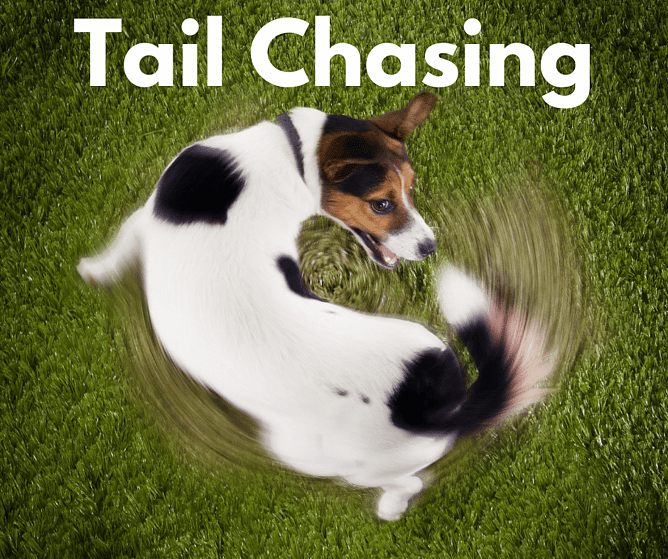
Tail Chasing
Tail chasing in dogs often seems to be associated with humorous videos, but while it may seem funny, let’s find out what could really be going on…
Obsessive Complusive Disorder
Tail chasing can be described as a typical obsessive compulsive disorder (OCD) in dogs. Compulsive means a repetitive, irresistible urge to perform a behaviour.
Other OCD behaviours include: spinning, pacing, fly snapping, barking, shadow or light chasing, excessive licking and toy fixation.
It is important to note that normal dogs will display these behaviours but in usually only response to specific triggers. For example, licking when itchy or barking in response to a sound.
Possible Causes
Tail Chasing is suggested to have a genetic predisposition as it is more common in certain breeds, such as Bull Terriers, German Shepherds and Staffordshire Bull Terriers.
Physical conditions can also cause tail chasing such as: anal gland problems, wounds, skin infections or itchiness and parasites.
Other possible causes:
Anxiety/stress
Boredom
Social conflict (for example frequent aggression from another pet)
Attention seeking
Excitement
Fear
Puppies may often start tail chasing out of curiosity.
First - Medical Check
It is very important to seek veterinary advice if your pet starts chasing their tail. Underlying medical conditions such as skin irritations, parasites, bacterial or viral infections, head injuries for example, all need to be treated by a vet before any behavioural modification plan is put into place and can be effective.
Identify and Remove/Prevent Triggers
Once a medical condition has been ruled out, try to identify what may trigger the tail chasing. Then, remove or prevent this. For example, if your dog is triggered to tail chase when they are excited or over aroused, try to interrupt or distract before your dog gets too worked up.
If the trigger is something more complex such as stress or anxiety, you may need to discuss this with a Behaviour Vet, and in some cases, medication may be required.
Redirect Attention
It’s important to redirect your dog’s attention away from their tail by interrupting tail chasing and redirecting your dog to do an incompatible behaviour such as sit, or target to hand. The more a dog practices the tail chasing, the more chance the behaviour has to become a true OCD behaviour and therefore much harder to change.
Don't Punish and Don't Accidentally Reinforce
Punishment in all forms from saying ‘no/ah ah’, to physical punishment such as hitting, will increase anxiety/stress and confuse the dog. In some cases, using punishment can even be reinforcing for attention seeking dogs.
Likewise, laughing at the behaviour can reinforce it.
Increase Mental Stimulation
For all types of OCD behaviours (and for all dogs in general), it is always beneficial to increase mental stimulation in the form of environmental enrichment. This will help to redirect attention or thoughts away from tail chasing, providing the enrichment is suitable and interesting for your dog. Spend some time finding out what sort of food toys your dog likes, and how to make their meals times as interesting as possible.
Contact Us
Get in touch with us or your vet for further help and for a plan specific to your dog.