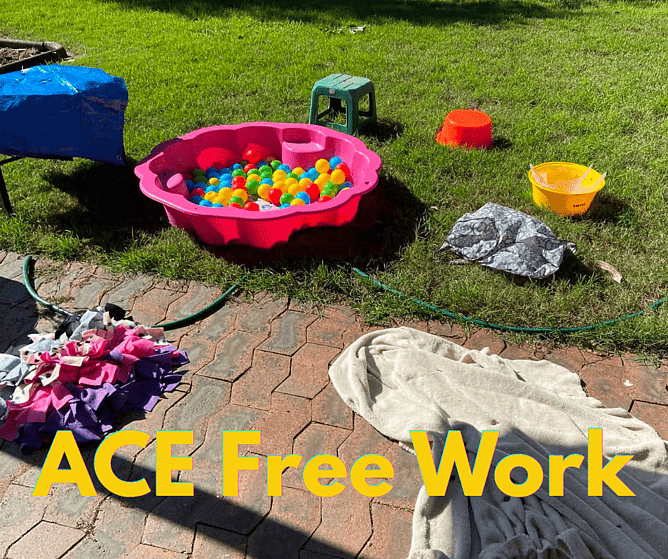
ACE Free Work
ACE Free Work was developed by Sarah Fisher as part of Animal Centred Education (https://animalcentrededucation.teachable.com/).
ACE Free Work is a great way to help your dog calm and relax. It naturally uses all your dog's senses and provides low impact exercise, sensory enrichment and the opportunity to explore and investigate. Free Work uses individual enrichment stations that support movement, regulation, and confidence and helps you learn what your dog’s posture, movement patterns, and choices are telling you.
How to do ACE Free Work
Choose a space/location
Ideally a space in your house or yard that is secure so your dog can move around freely, but you can take ACE Free Work on the road.
Collect your elements
Set out stations so there is a range of things to walk around:
Enrichment/engagement activities such as snuffle mats, lickimats, and ball pits; and a number of stations of different heights.
Different surfaces such as plastic, wood, towels, rugs, cardboard. Avoid surfaces that are slippery.
You also need to have water bowls, ideally more than one and one of them raised.
Prime the area with food
You will need three types of food: small, easy to eat treats; soft food that can be spread on surfaces, such as cream cheese or peanut butter; and larger crunchy but still edible chews.
Scatter the small treats on the surfaces and in the enrichment activities. Also scatter some on the ground near these so your dog does not have to step on surfaces to get the treats. Spread the soft food on lickimats and surfaces that your dog can lick. Hide a couple of the larger chews so that your dog can exercise their jaw. Always be aware of the potential for resource guarding and don't use these larger treats if this is an issue for your dog.
Observe
Let your dog explore the area freely and ideally with no equipment on them like a collar or harness (unless they are out of the home).
You don’t need to give them any guidance or encouragement, just let them explore in their own time.
Video your dog’s sessions and take note of movement, preferences and behaviours.
Modify as needed
You can change the elements within the set up and the location each time you do a session.
Advanced set ups
ACE Free Work is an ideal context to help your dog become more comfortable around things that concern them, including objects, other dogs or people. Your dog should be familiar with Free Work first.
This is done by first placing a reduced version of what they are concerned about in or near the Free Work set up. This could be a blanket with the scent of another dog, a toy dog or an article of human clothing.
Reducing triggers to less intense versions allows you to introduce things more slowly. You can also introduce dogs to things like harnesses, umbrellas or muzzles in this way.
Working like this within Free Work allows your dog to experience their triggers safely and with choice in a familiar environment that they already enjoy. You may be surprised by how much progress you make.
Contact us for more info on how we use ACE Free Work for things like reactivity and loose lead walking.
For more info about ACE Free Work and Animal Centred Education: